
Scaling battery-electric vehicle (BEV) architectures for heavy-duty applications involves nonlinear variables that differ significantly from those in passenger vehicle development. Standard industry practices, such as increasing energy capacity through additional modules or raising system voltage, encounter physical and thermodynamic limits when applied to high-mass platforms.
This FAQ examines the technical reasons why pack-level scaling is insufficient and identifies the systemic changes required.
Vehicle mass effect on energy consumption through mass compounding
In heavy-duty applications, energy consumption is governed by a recursive mass increase often referred to as a mass-compounding loop. Adding battery modules to extend range increases the vehicle’s curb weight, which necessitates more robust structural components and higher-torque electric motors. These additions further increase the total mass, requiring additional energy for propulsion.
Figure 1 shows that a 15% increase in vehicle weight results in an 8.89% increase in battery energy consumption under the UDDS urban cycle and a 6.02% increase under the HWFET highway cycle.
The consumption increase is non-linear. Scaling from a 1,600 kg car to a 2,000 kg midsize SUV increases energy requirements from approximately 280 Wh/mile to over 420 Wh/mile (Figure 2). Volumetric and weight constraints, such as the US Advanced Battery Consortium (USABC) target of 80 liters for a 40-mile range, establish a threshold where increasing battery mass produces diminishing returns in range.

Does raising system voltage (e.g., to 800 V) mitigate the challenges of heavy-duty scaling?
Transitioning to 800 V architectures reduces current draw for a specific power output, thereby lowering I²R losses and allowing for reduced cabling mass. However, higher voltage does not resolve the thermal degradation inherent in high-mass duty cycles.
Heavy-duty vehicles maintain high electrical loads for extended periods compared to passenger vehicles. According to a research study by the University of Warwick and Jaguar Land Rover, high-performance cycles can reach peak discharge powers of 300 kW and sustained RMS loads of approximately 228.1 kW.
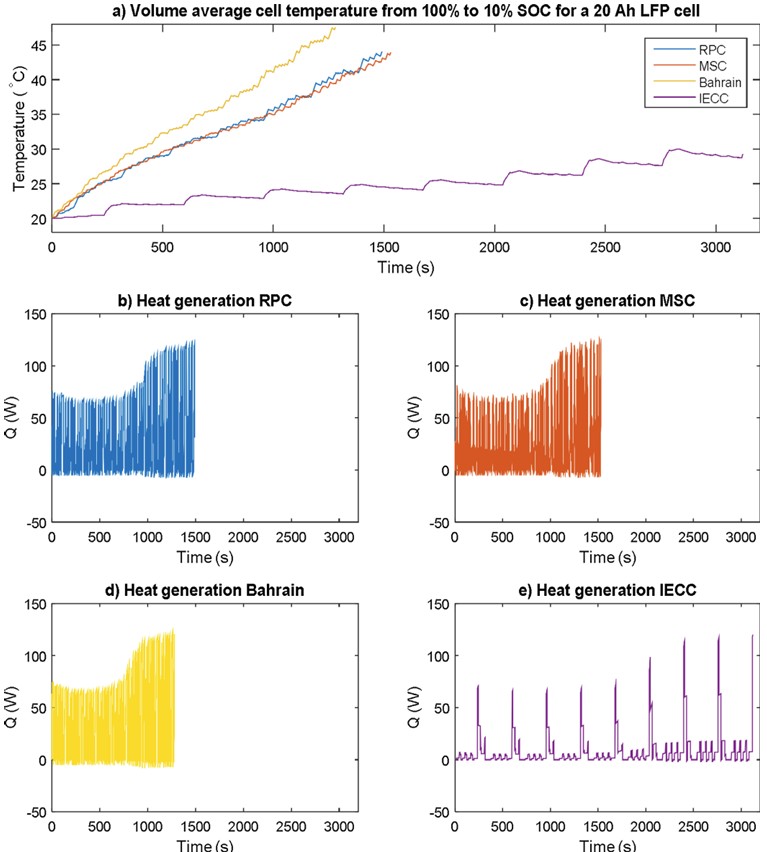
Figure 3 illustrates the thermal load under these conditions. In aggressive duty cycles (e.g., the Bahrain circuit simulation), average volumetric cell temperatures reach 47.5°C, generating 135 kW/m³ of heat. In contrast, standard IEC 62660-1 (IECC) testing profiles reach only 30.0°C and 30 kW/m³.
This thermal load accelerates degradation mechanisms, including electrolyte decomposition, transition metal dissolution, and solid-electrolyte interface (SEI) growth. Higher system voltage changes the electrical delivery but does not lower the heat generated by the cells during sustained high-power discharge.
What cell-level solutions are necessary to meet heavy-duty requirements?
Because pack-level expansion is constrained by weight and volume limits, heavy-duty range targets must be met by increasing the intrinsic energy density at the cell level. USABC targets specify benchmarks of 350 Wh/kg or 750 Wh/L.
Achieving these benchmarks requires a shift in electrode materials. Figure 4, which plots energy densities in Wh/L and Wh/kg, is useful for understanding the correlation between smaller size and lighter weight.
- Anode technology: Traditional graphite anodes have a chemical intercalation capacity limit of 372 mAh/g. Next-generation Silicon-based anodes provide theoretical capacities up to 4,212 mAh/g at elevated temperatures, and 3,579 mAh/g at ambient temperatures, allowing for significantly higher energy storage within the same mass
- Cathode composition: Traditional Lithium Cobalt Oxide cathodes are constrained by a limited practical capacity of just 140 mAh/g. To meet heavy-duty energy demands, the industry is transitioning to Nickel-rich layered oxides (such as NCM-811), which significantly elevate energy densities to between 273 and 300 Wh/kg.

Summary
Scaling electric architectures for heavy-duty use is a multi-physics challenge where vehicle mass reshapes energy, power, and thermal requirements. Standard battery configurations for passenger vehicles are limited by mass compounding and thermal bottlenecks. Engineering heavy-duty battery platforms requires coordinated changes across the system, integrating advanced cell chemistries with thermal management strategies designed for the high-load profiles of high-mass operation.
References
Impact of lightweighting and driving conditions on electric vehicle energy consumption: In-depth analysis using real-world testing and simulation, ScienceDirect
Battery Requirements for Plug-In Hybrid Electric Vehicles – Analysis and Rationale, National Renewable Energy Laboratory
Battery cycle life test development for high-performance electric vehicle applications, ScienceDirect
Maximizing energy density of lithium-ion batteries for electric vehicles: A critical review, ScienceDirect
EEWorld Online related content
Scaling Electrification: Why heavy-duty EVs are a different engineering challenge
How do onboard chargers differ between 400 and 800-V EV architectures?
What are the biggest challenges for EV battery thermal management?
One size does not fit all: How EV battery chemistries are evolving
How voltage impacts EV efficiency, performance, and cost?