Power over Coax (PoC) systems, which deliver both power and data over a single coaxial cable, require specialized diagnostic and monitoring techniques. Faults can occur in the cable or within the specialized hardware that injects and extracts power and data.
Some PoC protocols, such as the gigabit multimedia serial link (GMSL) and flat panel display (FPD) Link III, include built-in line-fault circuitry to detect conditions like short-to-ground, short-to-battery, and disconnected cables. Depending on the SerDes IC being used, line-fault detection can require adding external components, like inductors or resistors, to sense faults without impacting the high-speed data signals.
Some PoC configurations use external resistors to bias the coax cable and establish voltage levels for line-fault detection. For example, resistors R1 and R2 in Figure 1 are used for line fault detection. In this case, R1 is 49.9 kΩ for 5 V PoC and 133 kΩ for 12 V PoC, and R2 is 10.2 kΩ for both voltages.
BIST mode
Most SerDes cores include built-in self-test (BIST) functions in the form of a pseudo-random bit sequence (PRBS) pattern generator in the serializer and a corresponding pattern checker in the deserializer.
While it’s possible to emulate the PRBS pattern using an off-chip jitter injection filter, this can introduce unnecessary design challenges. A simpler approach can be to use a PoC SerDes core with integrated jitter injection capability. Advanced BIST implementations can also measure the ability of a SerDes to recover data correctly in the presence of specific levels of jitter.
In addition to basic data path testing, PoC-specific BIST functions include more detailed testing of both the power and data transmissions. For instance, some PoC systems can test for a short circuit and automatically shut down the power connection.
In the signal paths, BIST can evaluate the performance of adaptive equalizers in PoC SerDes that are used to compensate for signal degradation over the coax.
Many PoC SerDes ICs include comprehensive diagnostic functions that enable the system to access the overall condition of the link. That can be important in automotive systems where ISO 26262 mandates periodic checks for latent defects.
Back and forward channels for monitoring
Both the high-speed forward channel and the low-speed back channel can be used to carry diagnostic and control data in addition to their primary functions. The health of the coax cable and the connected devices can be monitored by sending specific signals tailored to measuring and evaluating the performance of PoC systems (Figure 2).
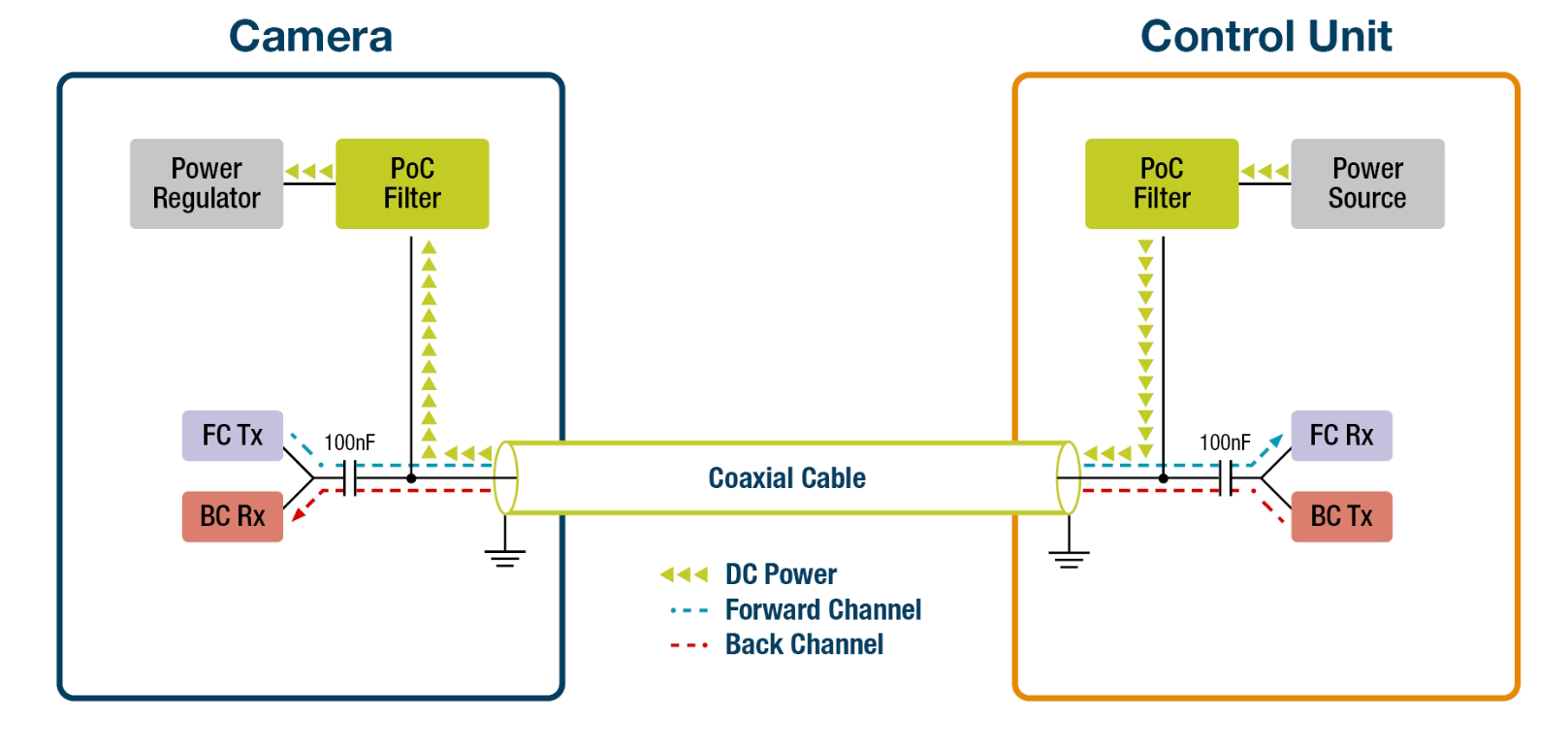
The back channel can be used to implement continuous monitoring of the health of the power delivery system. The powered device sends real-time data on the voltage it’s receiving and the current it’s consuming. If the parameters fall outside specified limits, an alert can be triggered.
Sudden changes in the power load can indicate a fault or failure of the remote device, or a degradation of the connecting cable. Line faults, such as shorts or open circuits, can also be detected, and the back channel is used to send a corresponding message to the central control.
The quality of the signals transmitted on both channels is a key indicator of the condition of the coax cable. If the signals are weak, it can indicate attenuation due to cable degradation or power loss at the transmitter.
The back channel can send information about the quality of the signal on the front channel, such as a signal-to-noise ratio (SNR) that falls outside acceptable limits. For example, if the signal is too noisy, there may be a fault with the electromagnetic interference (EMI) filtering that’s allowing external interference to leak into the PoC connections. This can be an especially important consideration in noisy environments like automotive systems.
Monitoring the performance of the forward and back channels and the power delivery can provide early identification of impedance mismatches due to poor filter performance or cable issues.
Summary
Monitoring and diagnostic tools are important to ensure the reliable operation of PoC systems. It’s more than a once-and-done situation; ISO 26262 requires periodic checks for defects. BIST provides a toolbox of functions for testing and confirming the performance of PoC systems. The bidirectional communication capabilities of PoC using the forward and back channels provide a solid framework for monitoring system performance in real-time.
References
Advanced Serdes Debug with a BERT, Tektronix
How to Test and Troubleshoot Coaxial Cables, AMPXL
How To Test Cable Signal Strength, Leo Network
How to Use GMSL Line-Fault Detection for Power Over Coax, Analog Devices
Power over Coax: a Design Guide for Automotive Applications, Texas Instruments
Pseudorandom binary sequence, Wikipedia
The Basics of Time Domain Reflectometry (TDR), HV Technologies
What Is a SerDes?, MathWorks
Related EE World content
Basics of coax cable
Coaxial cable myths and misunderstandings
The difference between TDR and spread-spectrum TDR
Five key considerations for spectrum analyzers
Test applications handle automotive SerDes, MIPI A-PHY and ASA standards