A concept design illustration of the Vimana Aero drone. | Source: SS Innovations
Dr. Sudhir Srivastava, CEO of SS Innovations International Inc., said he hopes the medical device company will have a functional, flying surgical robot sometime in mid-2026.
SS Innovations unveiled its conceptual plan for the Vimana Aero drone in April, raising two questions: Can it be done? And if so, why?
Srivastava told Medical Design & Outsourcing that the Indian Army approached SS Innovations with a predicament. Hemorrhage is the leading cause of death among soldiers because the wounded cannot be evacuated out of war zones quickly enough.
Inspired by U.S. Defense Advanced Research Projects Agency (DARPA) research in the 1980s, Srivastava developed a concept design that combined SS Innovation’s technology and teleconnectivity, which could minimize the time between the point of injury and medical care.
SS Innovations pushes the envelope for robotics in healthcare

A concept design of the Avtara humanoid robot. | Source: SS Innovations
The drone is just one of the “crazy, disruptive ideas” from SS Innovations to further expand access to telerobotic-assisted care, Srivastava said.
“I think the minute, as a philosophy, you become static, you are on a downhill course,” he said. “So, science must progress.”
SS Innovations launched SSi Mantra surgical robotic system in 2021. Since then, the Gurgaon, India-based company has introduced two new generations, including the SSi Mantra 3, which it recently submitted to the FDA for 510(k) clearance.
Srivastava said SS Innovations has installed more than 200 systems, and these systems have performed almost 11,000 surgeries, including 20 long-distance cardiac telesurgeries. SSi Mantra has earned regulatory approval in 14 countries.
The Mantra system’s telesurgical capabilities have shown low latency, Srivastava said, giving the company confidence that its technology could operate “anywhere.”
“Our focus is to really change the direction of surgery for as many patients as possible around the world,” he said. “The technology is available. All these things can be done.”
Surgical robots target emergency medical care
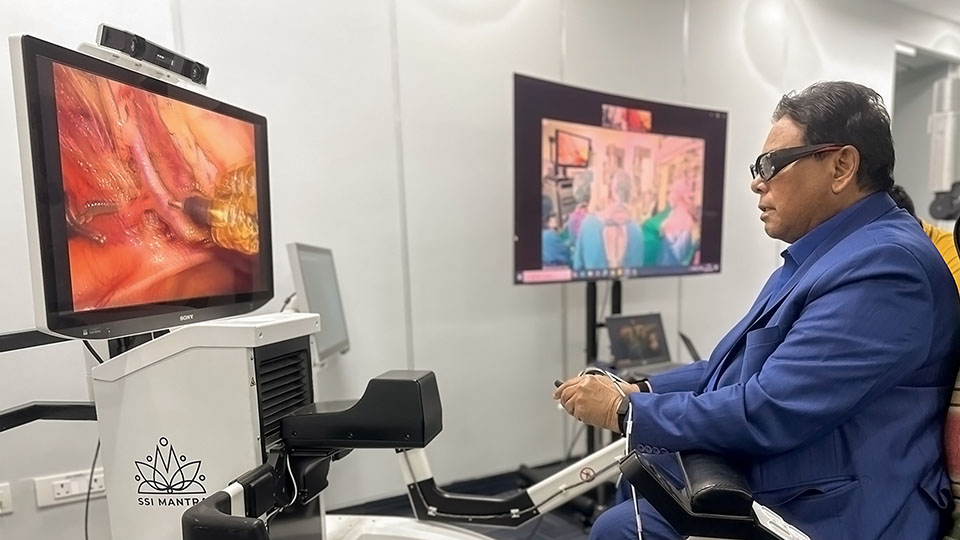
SS Innovations founder and CEO Dr. Sudhir Srivastava performs a remote procedure using the Mantra 3 system. | Source: SS Innovations
While Mantra’s telesurgical capabilities expand, Srivastava’s next projects focus on providing emergency care in war zones. The efforts hark back to robotic surgery’s origins: Intuitive Surgical and Computer Motion (which Intuitive purchased in 2003) emerged from DARPA–funded research in the 1980s and ‘90s to develop telesurgery for the battlefield.
SS Innovation’s Vimana Aero system is in the concept stage. It consists of a heavy-lift autonomous drone and a detachable unit with two miniature robotic arms with seven degrees of freedom and 5 mm (0.1 in.) surgical instruments.
In its current design, the completely remote-controlled drone will land near a patient to deploy the detachable unit to let a surgeon remotely address hemorrhaging, wound repair, chest decompression, shrapnel extraction, and field suturing to help stabilize patients until evacuation teams arrive.
“We have flown it around [as a demonstration of concept, but] it’s not functional yet,” noted Srivastava. “I’m hoping our team works very fast, and in two months, we will actually have a functional unit.”
The main challenges are payload and battery life, “and both are solvable,” he added.
“It comes down to the size of the drone in terms of flying distance or how long can you be in the air, and also payload,” Srivastava said, “so smaller robotic arms that we can produce … and 3D vision, which is not a problem at all. It’s available.”
Another challenge is the landing site.
“[When] the drones land, they will raise dust,” said Srivastava. “The way we are looking at the model where we will have a detachable underneath attached to it, so the drone can land itself somewhere away from where the soldier is, so we don’t contaminate further.”
Srivastava said the detachable unit could be a humanoid or a legged robot with arms attached to perform the remote-controlled procedures. SS Innovations recently unveiled development plans for its Avtara humanoid.
SS Innovations develops teleop capabilities for war zones
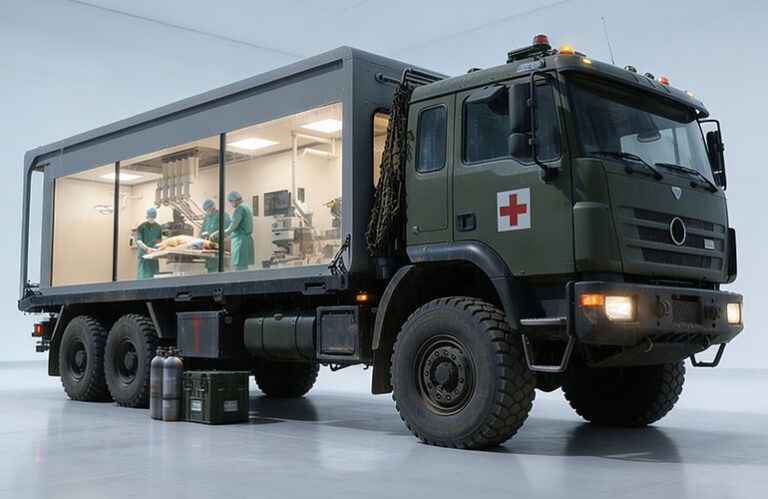
An illustration of the Operion mobile operating room. | Source: SS Innovations
SS Innovations is also looking into developing small operating areas away from active war zones or on army bases that could house robotic surgery systems to care for evacuated soldiers.
“Essentially, surgeons can [remotely] repair whatever needs to be done,” Srivastava said. “It’s mostly a bailout option just to save their life. Then you have that person airlifted and brought to these bases where you still have a robotic system to be able to provide that care.”
Srivastava said the Vimana Aero drone could be helpful beyond the battlefield and bring life-saving emergency care to areas where it’s inaccessible.
“Sometimes natural disasters occur, and people cannot get there: earthquakes or floods, landslides, etc.,” he said. “This technology can really be helpful, and it will have a real application. … I hope we can invest more money in saving people rather than killing each other.”
Srivastava is also developing an idea to truck an operating room to patients in remote locations with the SSi Operion mobile operating room. The conceptual design features a truck-mounted, fully functional operating room with suspended surgical components and telesurgical capabilities, like the U.S. Army’s mobile army surgical hospital (MASH) units.
The truck could help improve surgical care worldwide, Srivastava said.
“Almost 65% of the population in India lives in smaller communities or rural areas, and they just don’t get the access,” he said. “That problem exists everywhere. I think this can become a model.”
Editor’s note: This article was syndicated from The Robot Report sibling site Medical Design & Outsourcing.