Syensqo is powering electrification with an integrated range of busbar solutions, engineered to meet the unique requirements of various applications.
Following these guidelines, it has introduced its new Ryton PPS XE3500 Orange grade, an advanced material designed for extruded busbars in battery systems that offers superior heat stability and meets stringent high-voltage compliance standards.
Syensqo addresses complex electrical applications like inverters and e-motors with specialised, high-CTI injection-moulded materials designed for demanding environments. Key offerings in this portfolio are Amodel PPA Bios, Amodel PPA HFFR, and Ryton Supreme HV.
In an exclusive interview for Electronic Specifier, Nicolas Batailley, Marketing Manager Automotive at Syensqo, emphasised that by launching Ryton PPS XE3500 Orange and providing comprehensive busbar solutions, Syensqo is committed to facilitating customer innovation, offering support that spans the entire process from concept to validated real-world application.
Solutions to driving electrification
The automotive industry is facing numerous challenges related to electrification. The materials used in e-motors, batteries, and power electronics systems must meet new technical requirements to ensure the highest level of efficiency and safety.
Batailley added: “This is especially true with the development of 800V architectures, where performance demands are even more stringent.”
Busbars are key components of electrical circuits. They are found in electric motors, inverters and, of course, batteries. The specific technical requirements vary depending on each system.
The new Ryton PPS XE3500 Orange grade features
Busbars used in batteries are typically very long (several tens of centimetres). Extrusion is a particularly well-suited technology for this type of part.
“With new safety regulations for electric vehicles and the growing adoption of 800V batteries, traditional materials are reaching their limits, especially in terms of high temperature performance and fire resistance,” Batailley explained.
The colour orange is used to identify high-voltage components, an essential feature for personal safety. Ryton PPS XE3500 meets all these technical requirements: it is extrudable, fire-resistant, and can withstand very high temperatures.
Also, this material is directly compoundable (no masterbatch required), and extruded busbars can be formed into complex shapes after processing.
Advancements in materials for demanding electrical environments
Surface Tracking Resistance measures a material’s ability to resist electrical conduction across its surface. This is an important factor to consider when designing high-voltage applications such as busbars.
“In this respect, the greater the surface tracking resistance, the closer the spacing between the overmoulded connectors can be. This property is therefore crucial for both safety and the miniaturisation of electrical systems,” Batailley said.
Traditionally the automotive industry has used the Comparative Tracking Index (CTI) test developed by UL, which is limited to 600V. However, with the advent of 800V architectures, this standard was no longer sufficient. UL has since introduced a new standard UL 2597, extending testing up to 900V.
Batailley added: “Our Amodel PPA Bios HFFR is the first PPA on the market offering a Surface Tracking Resistance of 900V, fully tested and validated by UL – a truly groundbreaking achievement.”
Supporting the automotive industry
Syensqo’s grades for busbar applications enable automotive manufacturers to achieve the highest levels of safety and efficiency for end customers.
“Our technologies support the development of 800V architectures required for fast charging and meet the latest requirement in terms of thermal runaway protection. To summarise, our materials are helping to shape the future of e-mobility,” Batailley explained.
These materials are engineered to maintain excellent electrical insulation and dimensional stability, which is crucial for mitigating thermal runaway events in high-voltage (HV) battery packs.
A comprehensive portfolio of busbar solutions
Depending on where the busbars are used the technical requirements vary. These may include dimensional stability, thermal shock resistance, fire resistance, and high surface tracking performance.
Batailley added: “To meet these requirements, Syensqo has developed a comprehensive portfolio of solutions based on our high performance polymer families: Amodel PPA, Ryton PPS, and KetaSpire PEEK.”
Syensqo offers the Ryton PPS XE3500 Orange grade, a specialised material designed for high-voltage battery systems using extruded busbars. This grade provides significantly better heat stability compared to existing solutions.
Optimisation through advanced CTI simulation
The CTI simulation tool developed by Syensqo provides a unique advantage to customers developing busbars.
“It enables optimisation in two ways: by adapting part design to the specific Surface Tracking Resistance of a selected material, or conversely, by recommending the most suitable material for a given design,” Batailley underlined.
This integrated approach helps automotive manufacturers navigate complex requirements, particularly in applications like inverters and e-motors where specific material grades can exceed 900V in performance.
Ensuring robust real-world performance
Syensqo has developed all the necessary tests to validate busbar performance. These include:
- Electrical performance tests (insulation, CTI, etc…)
- Mechanical performance tests (thermal shock resistance, polymer adhesion, notably with the Air Leakage Test developed by the Application Development Team)
- Safety tests including thermal runaway resistance evaluations
Batailley added: “These comprehensive tests are part of Syensqo’s end-to-end engineering support, which helps automotive manufacturers achieve robust, real-world performance validation for their busbar designs.”
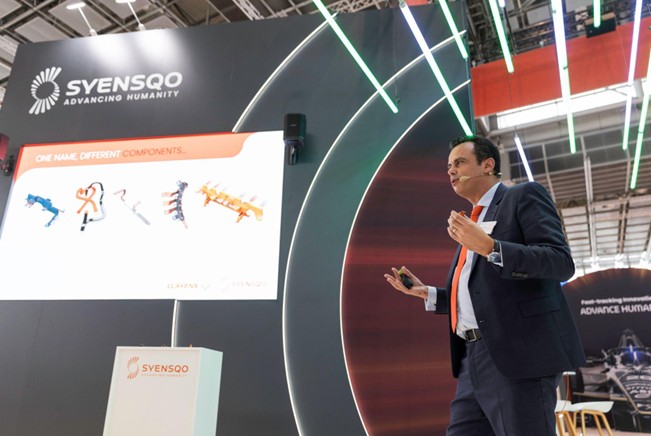
Presentation with Clayens on complex busbar development
The presentation aimed to demonstrate the power of technical collaboration. As mentioned, busbars vary widely in design, technical requirements, and manufacturing processes.
“During the presentation, Syensqo showcased its latest innovations and expertise in material selection, while Clayens addressed the complexity of design and manufacturing process,” Batailley said.
This demonstrates how innovation in materials and processes is inseparable from achieving optimal final pieces that fully satisfy the expectations of the end customer.
Considerations to keep in mind
Syensqo offers a ‘one-stop-shop’ approach, supporting customers throughout the entire busbar development cycle.
“This includes design recommendations, material selection, digital validation, and part testing – ensuring a seamless process from concept to validation,” Batailley explained.
This comprehensive approach is designed to facilitate robust, real-world performance validation for high-voltage systems and can result in significant design and manufacturing efficiencies for automotive OEMs and Tier 1 suppliers.
“Through our innovative materials and one-stop-shop approach, Syensqo continues to help shape the future of complex busbar systems – driving the electrification of mobility with performance, safety, and sustainability at the core,” Batailley concluded.
About the author:

Diego de Azcuénaga, Contributing Writer